Every gardener knows that the secret to a bountiful harvest lies beneath the surface. While we often focus on sun, rain, and selecting the perfect seeds, the true foundation of any successful vegetable patch or flower bed is the soil structure. Roots need a delicate balance of air, moisture, and nutrients to thrive. Achieving this “fine tilth” by hand with a spade is back-breaking work that can take days of strenuous effort. This is why mechanical soil preparation tools are indispensable for the modern horticulturist.
However, the terminology can be confusing. You will often hear the words tiller, rotavator, and cultivator used interchangeably, but they refer to machines with distinct capabilities. Choosing the wrong one can lead to frustration. A machine that is too light will bounce harmlessly off hard clay, while a machine that is too heavy can destroy the delicate structure of a raised bed.
At Compass Garden Machinery, we stock a comprehensive range of soil preparation tools designed to tackle everything from breaking virgin ground to gently weeding between rows of established corn. This guide explores the differences between these machines and highlights specific models from our catalogue to help you make the right choice for your plot.
The Quick Answer
What is the difference between a Tiller, a Rotavator, and a Cultivator? While the terms overlap, the difference generally comes down to power and the position of the digging tines. Cultivators (or Mini Tillers) are lightweight machines designed for surface work. They are perfect for mixing compost into soft soil and weeding between rows. Front-Tine Tillers are the standard all-rounders where the tines drive the machine forward. They are ideal for annual turning of established vegetable plots. Rear-Tine Tillers (often called Rotavators) are heavy-duty beasts where the wheels are driven separately from the tines. These are the only choice for breaking hard, compacted ground or virgin turf that has never been cultivated before.

The Heavyweights: Rear-Tine Tillers
If you are faced with a patch of ground that has not been touched in years, or if your soil has a high clay content that bakes hard in the summer, a standard tiller simply will not cut it. You need a machine with independent drive wheels and substantial weight. This is the domain of the Rear-Tine Tiller.
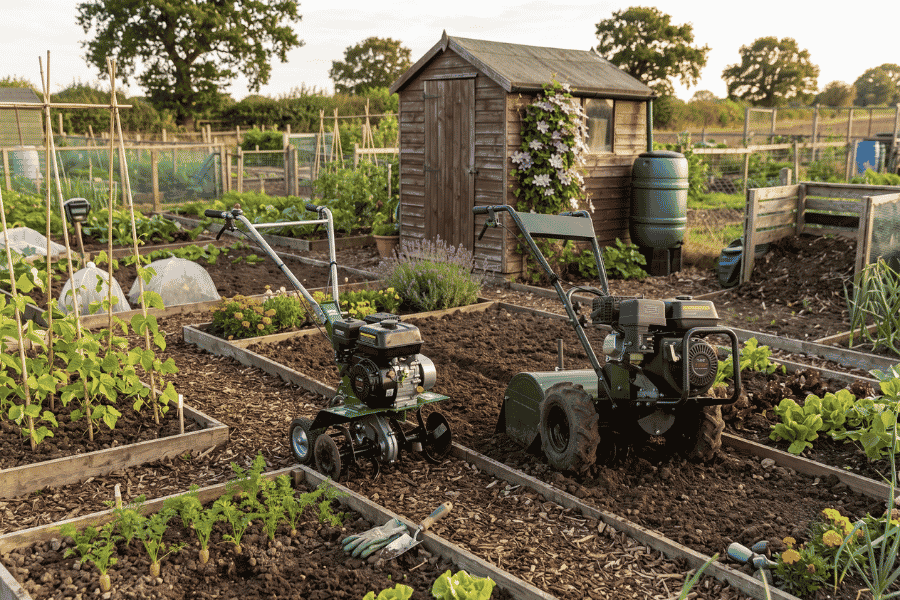
Unlike standard models where the spinning tines pull the machine forward, a rear-tine tiller has large pneumatic tyres that drive the unit at a steady pace. The digging tines are located behind the wheels and often rotate in the opposite direction to the wheels (counter-rotating). This creates a powerful digging action that forces the tines deep into the earth without the machine “running away” from you.
At Compass GM, we offer several machines in this category that provide exceptional value. The Racing 196cc Rear-Tine Tiller is a prime example of a machine built for tough tasks. With its substantial weight and powerful 4-stroke engine, it churns through sod and compacted earth with ease. For those looking for professional-grade durability, the Bertolini range offers Italian engineering at its finest. These machines feature heavy-duty gearboxes designed to withstand the immense torque required to break new ground day after day.
The primary benefit of our Rear-Tine Tillers is safety and control. Because the wheels govern the speed, the machine does not jump or bounce when it hits a rock or a hard root. It simply grinds through it. If you are starting an allotment from scratch or expanding your growing area into a lawn, this is the only tool for the job.

The Versatile Workhorses: Front-Tine Tillers
For the majority of home gardeners and allotment holders, the Front-Tine Tiller is the perfect middle ground. On these machines, the tines are mounted underneath the engine and act as the driving force. As they dig into the soil, they pull the machine forward.
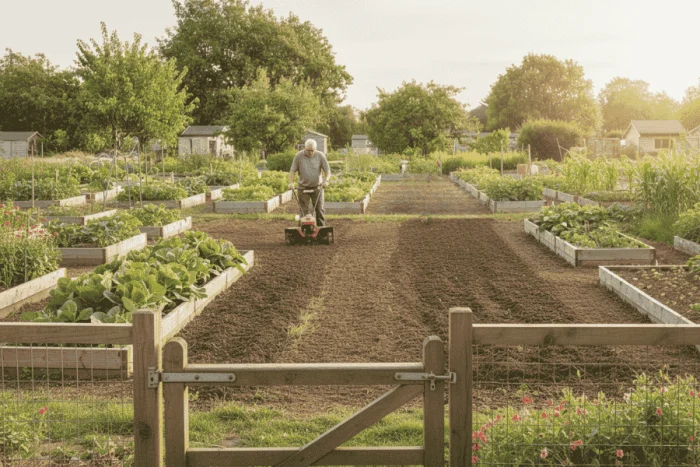
These units are generally lighter and more manoeuvrable than their rear-tine cousins. They are designed for “secondary tillage,” which means preparing seedbeds in ground that is already reasonably loose or has been cultivated in previous years. They are excellent for mixing in manure, peat, or fertiliser at the start of the season.
One of the standout models we stock is the Spectrum TG60FTTR. Exclusive to Compass GM, this machine offers a generous working width, allowing you to cover large areas quickly. Crucially, it features a reverse gear. This is a feature you might not think you need until you have it. When you are tilling up to a fence or a hedge, being able to reverse out of a tight spot without physically dragging the machine is a game-changer.
We also stock the Stiga SRC 36 V, a compact and reliable tiller perfect for medium-sized gardens. Stiga is renowned for its build quality, and this model offers a great balance of power and portability. For those seeking maximum value, the Racing range provides high-spec engines at a price point that makes ownership cheaper than hiring a machine for a weekend.
When using our Front-Tine Tillers, the depth is usually controlled by a “skid bar” at the back of the machine. By pushing down on the handlebars, you force the skid bar into the ground, which acts as a brake and allows the tines to dig deeper. It takes a little practice, but once mastered, it allows for incredibly precise soil turning.

Precision Engineering: Mini Tillers and Cultivators
Sometimes, raw power is not the answer. If you are working in raised beds, narrow flower borders, or weeding between closely planted rows of crops, a large tiller is more of a liability than a help. You need something lightweight, agile, and precise.
This is where the Mini Tiller shines. These machines are designed to be lifted with one hand and operated with fingertip control. They do not dig deep enough to damage the root systems of established trees or shrubs, making them perfect for refreshing mulch or aerating the topsoil to improve water drainage.
An excellent option is the Honda F220. While small, it benefits from Honda’s world-class 4-stroke engine technology. It starts easily, runs quietly, and offers the reliability professionals trust. It bridges the gap between a mini cultivator and a larger tiller, offering enough grunt to dig properly while remaining light enough to handle easily.
Our range of Mini Tillers allows you to ditch the hoe and the hand fork. They turn the chore of weeding into a task that takes minutes rather than hours, leaving your soil looking pristine and professionally manicured.

The Quiet Option: Electric Tillers
For urban gardeners or those with smaller plots near neighbours, the noise and fumes of a petrol engine can be a significant drawback. Fortunately, battery and electric motor technology has advanced to the point where Electric Tillers are a viable alternative.
Gone are the days of mixing fuel and oil or pulling starter cords. With an electric tiller, you simply plug in and go. They are virtually maintenance-free and produce zero emissions at the point of use.
The Mantis Electric Mini-Tiller brings the famous Mantis performance to an electric platform. It retains the aggressive tine design that made the petrol version famous but in a whisper-quiet package. It is surprisingly powerful, capable of handling established garden soil with ease. The instant torque of the electric motor means there is no “lag” when you hit a tougher patch of earth.
For small vegetable patches, raised beds, or greenhouse work, our Electric Tillers offer a plug-and-play solution that takes the hassle out of soil preparation.
Conclusion
Investing in a tiller or rotavator is an investment in your soil’s health and your own physical well-being. By automating the hardest job in the garden, you free up time and energy to focus on planting and harvesting.
Whether you need the brute force of a Feider rear-tine machine to break a new allotment, the versatility of a Spectrum front-tine tiller for your vegetable patch, or the precision of a Mantis for your flower beds, Compass Garden Machinery has the right tool for the job.
Browse our full range today and get ready to transform your earth into the perfect growing medium.