There is nothing more frustrating than buying a replacement chain for your chainsaw, taking it home, and finding it is half an inch too short or hangs loose on the bar.
Chainsaws are precision instruments. Unlike a lawnmower blade, which might fit several different models, a chainsaw chain must match the saw’s drive sprocket and guide bar exactly. If you try to force the wrong chain onto an Echo pruning saw or a Feider electric chainsaw, it will not just cut poorly – it is actively dangerous. It can jump off the bar (derail) or snap under tension.
However, finding the right chain is often confusing. Manufacturers use technical terms like “pitch,” “gauge,” and “drive links”, which can sound like a foreign language. You cannot simply ask for a “16-inch chain” because a 16-inch chain for an Efco forestry saw is completely different from a 16-inch chain for an Oleo-Mac hobby saw.
At Compass Garden Machinery, we stock chains for everything from small electric pruners to heavy-duty forestry saws. This guide demystifies the measurements so you can order the perfect replacement for your specific machine.
The Quick Answer
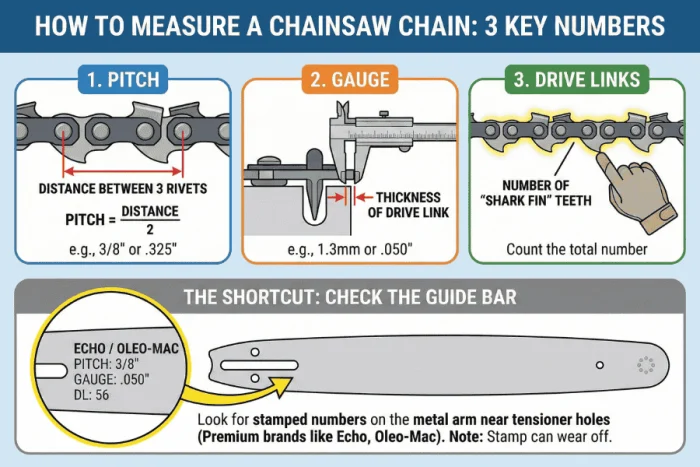
How do I measure my chainsaw chain? You need three specific numbers to identify a chain: Pitch, Gauge, and Drive Link Count.
Pitch: The distance between the rivets (e.g., 3/8″ or .325″).
Gauge: The thickness of the drive link that fits into the bar groove (e.g., 1.3mm or .050″).
Drive Links: The number of “shark fin” teeth on the inside of the loop. The Shortcut: Look at the base of your guide bar (the metal arm). Most premium brands like Echo and Oleo-Mac stamp these three numbers right there on the metal near the tensioner holes. If the stamp is worn off, you will have to measure them manually using the steps below.
Step 1: Count the Drive Links (The Most Critical Step)
This is the number one mistake people make. They measure the length of the bar (e.g., 16 inches) and assume any 16-inch chain will fit. This is wrong.
A 16-inch bar on a Feider electric saw might require 56 drive links. A 16-inch bar on an Echo petrol saw might require 57 drive links. If you buy the 56-link chain for the Echo, it will be too short to mount.
How to count: Take the old chain off the saw. Lay it flat on a table so the drive links (the pointy bits that sit inside the bar groove) are facing you. Count every single one. It sounds tedious, but it is the only way to be 100% sure. Use a marker pen to mark the first one so you do not lose track.
Common counts for these brands are 40, 45, 52, 56, 57, 62, 66, and 72.
Step 2: Determine the Pitch
The “Pitch” is essentially the size of the chain links. It is the average distance between three consecutive rivets divided by two.
Common Pitches for Compass GM Brands:
1/4″: Often found on very small Echo carving saws and top-handle pruning saws.
3/8″ Low Profile (LP): The most common pitch for domestic saws. You will find this on almost all Feider electric chainsaws and smaller Oleo-Mac homeowner models (like the GSH 400).
.325″: The standard for mid-range farm saws. If you own an Efco MTH 5100 or a mid-sized Echo CS-4510, this is likely your pitch.
3/8″ Standard: Used on heavy-duty professional felling saws like the larger Echo CS-620SX.
How to measure: Measure the distance between three consecutive rivets (heads) in inches. Divide that number by 2.
Example: Distance is 0.75 inches. Divided by 2 = 0.375 (which is 3/8″).
Example: Distance is 0.65 inches. Divided by 2 = 0.325.

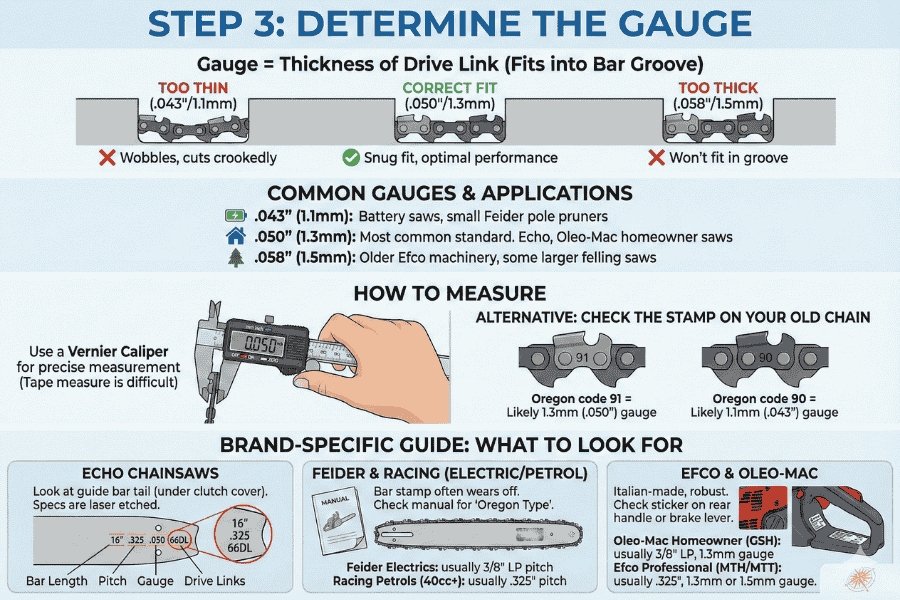
Step 3: Determine the Gauge
The “Gauge” is the thickness of the drive link. It determines how snugly the chain fits into the groove of the guide bar. If the gauge is too thin, the chain will wobble and cut crookedly. If the gauge is too thick, it simply will not fit in the groove.
Common Gauges:
.043″ (1.1mm): Very thin, used on battery saws and some small Feider pole pruners.
.050″ (1.3mm): The most common standard. Most Echo and Oleo-Mac homeowner saws use this gauge.
.058″ (1.5mm): Historically common on older Efco machinery and some larger felling saws.
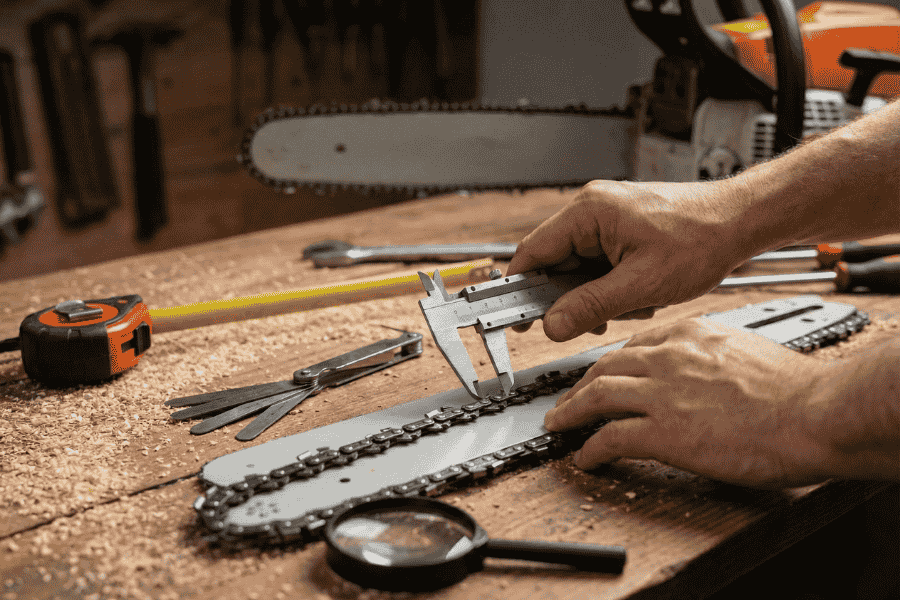
How to measure: This is hard to do with a tape measure. You really need a vernier calliper to measure the thickness of the drive link. Alternatively, check the stamp on your old chain.
If you see the number 91 on the drive link (Oregon code), it is likely a 1.3mm gauge.
If you see the number 90 (Oregon code), it is likely a 1.1mm gauge.
Brand-Specific Guide: What to Look For
Different manufacturers have different habits for marking their bars and chains. Here is where to look on your specific machine.
Echo Chainsaws
Echo is excellent at stamping specifications. Look at the tail of the guide bar (the end hidden under the clutch cover). You will usually see a laser etching that says something like: 16" .325 .050 66DL This tells you instantly: 16-inch bar, .325 pitch, .050 (1.3mm) gauge, 66 Drive Links.
Feider & Racing (Electric/Petrol)
On budget-friendly brands like Feider and Racing, the bar stamp can wear off quickly. However, the manual usually lists the “Oregon Type” chain.
Feider Electrics almost always use 3/8″ LP pitch.
Racing Petrols usually use .325″ pitch for 40cc+ models.
Efco & Oleo-Mac
These Italian-made saws are robust and follow European standards.
Homeowner Models (Oleo-Mac GSH series): Typically use 3/8″ LP pitch and 1.3mm gauge.
Professional Models (Efco MTH/MTT series): Typically use .325″ pitch and 1.3mm or 1.5mm gauge. Check the sticker on the rear handle or the brake lever, as the chain specs are often printed there for quick reference.
Conclusion
Measuring a chainsaw chain seems complicated, but it follows a strict logic. You are essentially matching the chain to the specific geometry of your saw’s sprocket and bar.
The Golden Rule: Never guess. If you order a “16-inch chain” for your Echo CS-420 without knowing the pitch, you might end up with a chain designed for a Feider electric saw, and it will not fit.
If you are unsure, the safest method is to bring your old chain (or the whole saw) into Compass Garden Machinery. Our experts can measure the wear on your bar, check the drive sprocket for damage, and cut a new loop of chain from our bulk reels to the exact length you need. We stock professional-grade chain loops specifically for Echo, Efco, Oleo-Mac, and Feider machines.
Need a new chain? Browse our Chainsaw Accessories.
Unsure? Contact Us with your saw model number, and we will find the correct part for you.